The $149M Problem: How Additive Manufacturing Is Transforming Oil & Gas Spare Parts
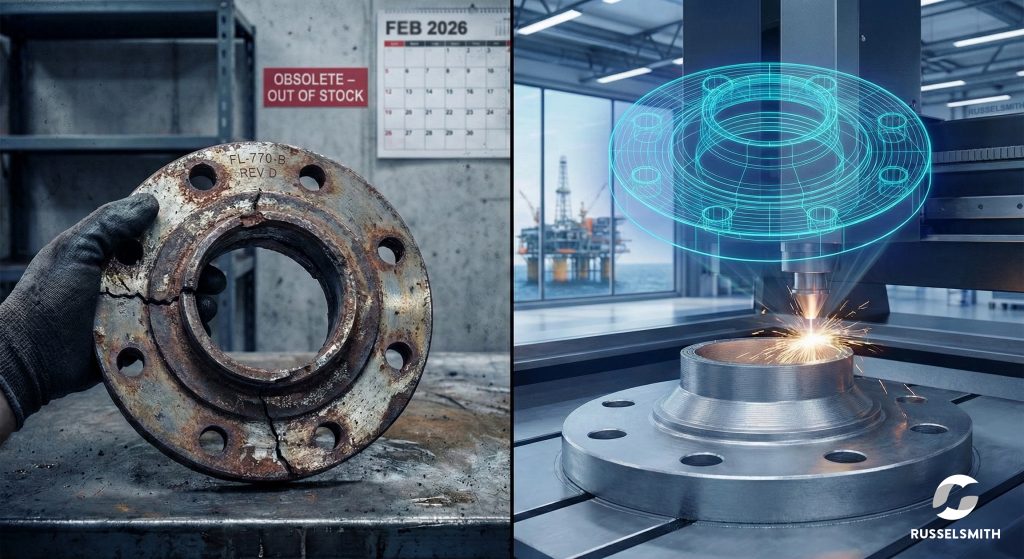
Understanding the Hidden Economics of Downtime
Maintenance managers in the oil and gas industry will most likely be familiar with this sinking feeling: a critical component has failed on a 25-year-old compressor system, production has stopped, costing thousands of dollars per hour, and the original equipment manufacturer went out of business a decade ago, leaving no supported supply chain for replacement parts.
The numbers behind this scenario are staggering. According to a 2022 Senseye Predictive Maintenance industry report by Siemens, offshore oil and gas facilities experience an average of $149 million in costs from unplanned downtime annually. What is more sobering is that such figures remain stubbornly high despite operators’ continuous investments in reliability improvements and predictive maintenance technologies.
The question is not whether critical oil and gas equipment will fail. In an industry characterised by extreme temperatures, corrosive environments, and constant mechanical stress, failures are inevitable. The real question is: why, despite billions of dollars invested in spare parts inventory, are operators still losing hundreds of millions to preventable delays?
The answer reveals a fundamental paradox at the heart of oil and gas supply chain management: companies are simultaneously overstocked and critically under-prepared.
When production stops at an oil and gas facility, the meter starts running immediately. Industry stakeholders commonly report unplanned downtime costs ranging from $125,000 to $500,000 per hour, with the exact figure depending on facility size, production capacity, and current oil prices.
During the 2021-2022 period, industry analysis indicated downtime costs increased by over 76% compared to previous years, driven largely by oil prices that peaked at nearly 300% higher than 2019-2020 levels. According to the US Energy Information Administration, Brent crude oil averaged $114 per barrel from March through June 2022, with the International Energy Agency reporting prices around $124 per barrel in mid-June. When oil sells for $120 per barrel versus $40, every hour of lost production becomes exponentially more expensive.
But these headline figures only capture part of the story. The true cost extends far beyond lost revenue to encompass emergency logistics fees, overtime pay, helicopter transport to offshore locations, and premium pricing for emergency procurement. Then come the indirect costs: safety risks from rushed repairs, contract penalties for missed deliveries, regulatory scrutiny, and potential environmental remediation costs. Perhaps most insidious are the opportunity costs, the capital tied up in excess inventory which earns no return, engineering resources diverted from value-adding projects, and lost market opportunities during high-price periods.
The oil and gas industry’s spare parts challenge is rooted in three interconnected realities that traditional supply chain models struggle to address. Standard lead times for specialised industrial components commonly range from 12 to 30 weeks under normal circumstances. For legacy parts, components for equipment that have been in service for decades, lead times can stretch to 12 months or more. This assumes no complications: no customs delays, no manufacturing backlogs, no shipping disruptions.
In Nigeria and across West Africa, where many oil and gas assets have been active from the 2000s and even from the 1990s in some cases, the legacy parts problem is particularly acute and will intensify over the next 5-10 years. Equipment from that era often requires components that original manufacturers no longer produce, forcing operators into expensive custom manufacturing arrangements or risky aftermarket sourcing. The geographic challenge compounds the problem. Oil and gas operations frequently occur in remote locations: offshore platforms, deep-water installations, frontier exploration sites. Delayed component shipments have caused weeks of halted operations, not because parts were exotic or complex, but because they were sourced overseas with no alternative supplier or local inventory available. In parts of Africa, routine logistics face obstacles including inconsistent port infrastructure, customs bureaucracy, and security concerns that complicate ground transportation.
This is where the economics become truly counterintuitive. As Carlo De Bernardi, Additive Manufacturing Lead at ConocoPhillips, noted in an interview: “The oil and gas industry has billions of dollars of spare parts in inventory at any given time.” Oil and gas operators often spend 20-40% of operating expenditures on equipment maintenance and reliability, particularly in asset-intensive facilities. Despite this substantial investment, operators still experience costly delays when critical parts are not in stock at the exact locations where they are needed. The result is a supply chain that is bloated and fragile, with warehouses full of parts that may never be used, whilst critical operations wait weeks for components that were not anticipated. This unoptimised inventory situation is driven by the fundamental uncertainty of what will fail, when, and where, and an inability to respond with agility at the points of need.
The Industrial Additive Manufacturing Solution
The adoption of industrial additive manufacturing, commonly known as industrial 3D printing or industrial 3D manufacturing, represents a fundamental rethinking of spare parts logistics. Instead of storing excess physical parts in warehouses around the world, industrial additive manufacturing enables a “digital inventory” model where spare parts are stored as validated CAD files in secure digital libraries. When a component fails, the digital file is sent to the nearest qualified manufacturing facility, or directly to the site itself, where the part is produced on demand.
This is not theoretical. Leading oil and gas operators are already implementing digital spare parts strategies with measurable results. An EOS case study involving check valves for a global oil and gas valve services provider recorded a lead time reduction from over 52 weeks to one week, a 15% reduction in component weight, and a total cost of ownership reduction of at least 30%, alongside a significant reduction in physical inventory requirements. In documented cases involving critical component failures in offshore systems, additive manufacturing has enabled emergency responses that would have been impossible with conventional supply chains.
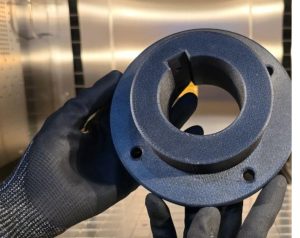
Components facing 12-16 week conventional lead times have been reverse-engineered and produced in 2-3 weeks, with design improvements for enhanced performance in corrosive offshore environments.
Different additive manufacturing technologies serve different applications. Wire Arc Additive Manufacturing and Directed Energy Deposition are ideal for large components, repair work, and applications requiring established welding materials. These processes are closely related to structural welding, which helps with qualification requirements. Powder Bed Fusion suits complex geometries and components requiring tight tolerances. It is commonly used for smaller, intricate parts like valve internals and instrumentation components. Cold Spray Additive Manufacturing excels at rapid manufacturing of high-performance components.
Material options for oil and gas applications now include high-performance alloys that are well suited to additive manufacturing. Nickel-based superalloys such as Inconel 625 and 718 are widely used for high-temperature and high-pressure service. 316L stainless steel remains a common choice for general corrosion resistance and is one of the most mature materials in metal AM. Super duplex stainless steels are increasingly qualified for offshore and subsea environments where resistance to chloride stress corrosion cracking is critical. Engineering polymers such as PEEK also enable non-metallic AM applications, including chemically resistant and high-temperature components.
A critical consideration in oil and gas adoption is ensuring that additively manufactured parts meet stringent safety and performance requirements. Established qualification frameworks now support this transition. Standards such as DNV-ST-B203, issued by DNV, provide structured pathways for qualifying metallic AM components in oil, gas, and maritime applications. American Petroleum Institute API 20S defines requirements for the qualification of AM metallic components used in petroleum and natural gas industries, particularly for pressure-containing and pressure-controlling parts. American Welding Society AWS D20.1 establishes fabrication and quality requirements for metal additive manufacturing.
Together, these frameworks enable performance-based qualification of AM parts, including pressure-retaining and safety-critical components, subject to project-specific validation and operator approval.
When Does Additive Manufacturing Make Economic Sense?
Not every spare part is a candidate for additive manufacturing, of course. The technology’s value proposition is strongest for low-volume, high-value parts needed infrequently but critical when required; long lead-time components with conventional lead times exceeding 12 weeks; obsolete or legacy parts no longer manufactured by OEMs; remote location operations with poor logistics; custom or modified designs requiring adaptation for specific conditions; and emergency situations requiring immediate response.
It is less suitable for high-volume commodity parts with established supply chains, simple geometries easily manufactured conventionally in large batches, or applications without qualified materials. The decision framework should consider lead time savings value, inventory reduction potential, failure frequency, design optimisation opportunity, and strategic importance of local manufacturing capability.
Forward-thinking operators are approaching additive manufacturing implementation in phases, most often in partnership with established additive manufacturing providers. This delivers faster results without significant capital investment. The process typically begins with assessment, where the AM provider works with the operator to audit existing spare parts inventory, identify high-impact legacy components with obsolescence issues or long lead times, and prioritise candidates based on criticality, failure frequency, and potential cost savings.
Priority components are then reverse-engineered and tested to verify they meet or exceed original performance specifications. This process creates documented evidence that the part is safe and fit for purpose, satisfying internal engineering requirements and industry standards. Once parts are qualified, the AM provider builds a secure digital library of validated component files, integrates into the operator’s procurement and maintenance workflows, and provides training to maintenance and engineering teams on when and how to leverage AM for spare parts. As the operator’s digital inventory grows, parts are produced on-demand, creating a flexible supply chain without inventory overhead. This partnership model provides immediate access to AM technology whilst avoiding the complexity of managing the technology internally.
The West African Opportunity
For operators in West Africa, additive manufacturing presents a unique opportunity to address longstanding infrastructure challenges whilst building local manufacturing capacity. Nigeria’s oil and gas sector faces particular pressures: aging infrastructure with significant portions of pipeline networks installed in the 1980s and 1990s, complex logistics across both onshore and offshore operations, and a strategic imperative to develop local content and manufacturing capability.
The Federal Government of Nigeria’s recognition of advanced manufacturing’s strategic importance, evidenced by investment incentives for manufacturing operations, signals policy support for technology adoption. Moreover, West African operators face some of the longest and most complex supply chains globally. A spare part shipped from Europe or Asia to a Nigerian offshore installation may take 8-16 weeks under optimal conditions. Local or regional AM capability can compress this to days.
The spare parts challenge in oil and gas is not just an operational issue; it is a strategic vulnerability. Companies that continue to rely solely on traditional supply chain models will find themselves increasingly exposed to disruptions, delays, and competitive disadvantage. Industrial additive manufacturing offers a pathway from reactive, inventory-heavy approaches to proactive, agile supply chains, and more resilient operations. The technology has matured beyond experimentation. Standards exist, materials are qualified, and early adopters are already realising measurable benefits.
The question for operators is not whether to explore additive manufacturing, but how quickly to move from exploration to implementation. In an industry where every hour of downtime carries six-figure costs, the economic case for action is compelling. For West African operators, the opportunity is even more significant: to not just solve immediate supply chain challenges, but to build the local manufacturing capabilities that will define the region’s industrial competitiveness for decades to come.
About RusselSmith Group
RusselSmith is a leading Nigerian provider of innovative asset integrity and advanced manufacturing solutions for critical industries across West Africa. As an ISO-certified organisation with operations spanning oil and gas, maritime, aerospace, and defence sectors, RusselSmith maintains cutting-edge additive (3D) manufacturing capabilities and strategic partnerships with leading original equipment manufacturers.
RusselSmith has established Nigeria’s first sovereign, multi-technology industrial 3D manufacturing capability via its Omnifactory, a facility that addresses a critical supply chain vulnerability in the West African region by enabling rapid in-country production of essential spare parts, components, and specialized hardware. These capabilities are reducing import dependencies, promoting homegrown innovation, building local technical capacity in cutting-edge fields, and improving operational readiness across vital industrial sectors.
For more information about RusselSmith’s 3D manufacturing capabilities or to discuss how digital spare parts strategies can benefit your operations, contact us.
Sources & Further Reading
Industry Data & Statistics: Senseye Predictive Maintenance. (2022). The True Cost of Downtime 2022. Siemens. Access report
Additive Manufacturing in Oil & Gas: Toensmeier, P. (2023). “ConocoPhillips Sees Oil and Gas Supply Chain Opportunity With Additive Manufacturing.” Additive Manufacturing Media. Read article
This article is part of The RusselSmith Brief series, providing strategic insights on industrial technology and operations across West Africa’s critical infrastructure sectors.